Baseline Evaluation of the Patient with Chronic T. cruzi Infection
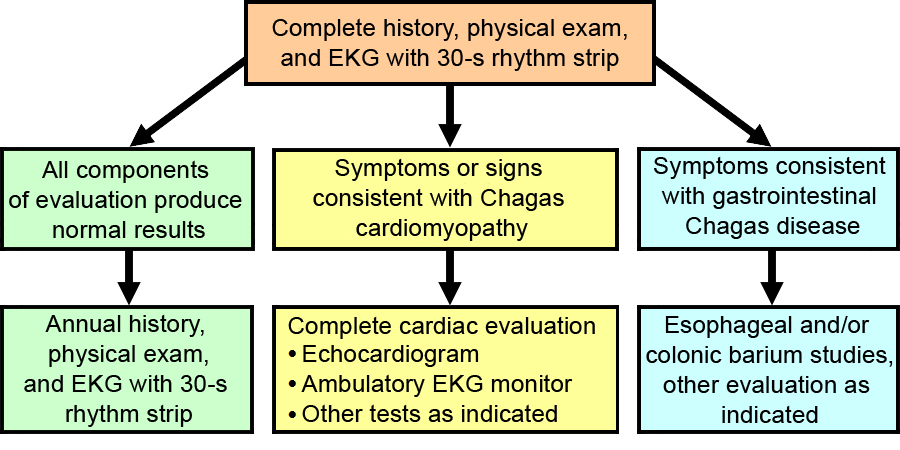
This page shows a flowchart that details the process for evaluating a patient with Chronic T. cruzi infection. The following pages illustrate each section of the flowchart, but the following is a brief synopsis. Much of this information is repeated on later pages. You may skip to navigation or continue reading.
Once chronic T. cruzi infection has been confirmed, the newly diagnosed patient should undergo a thorough baseline evaluation, including:
- History of potential exposure to the parasite in endemic areas, via blood transfusion or other routes
- Complete physical examination
- Resting 12-lead electrocardiogram with a 30-second lead II rhythm strip
The history should include a thorough review of systems, with an emphasis on symptoms suggestive of cardiac arrhythmias, early congestive heart failure and gastrointestinal disease.
Patient with chronic Chagas disease and no signs or symptoms
If the patient has no symptoms or signs of chronic Chagas disease on this baseline evaluation, the likelihood of significant morbidity is low. He or she should have a yearly history and physical examination, plus EKG with 30-second rhythm strip.
Patient with signs of Chagas cardiomyopathy
If the patient has symptoms or EKG findings suggestive of Chagas cardiomyopathy, a complete cardiac evaluation should be performed, including echocardiogram, ambulatory EKG monitoring and other tests as indicated by the individual findings.
Patient with signs of Chagas gastrointestinal disease
If the patient has symptoms suggestive of Chagas gastrointestinal disease, barium studies should be performed. The likelihood of significant gastrointestinal involvement in the absence of symptoms is low.
Barium studies are more sensitive for the diagnosis of gastrointestinal Chagas disease than endoscopy. However, the latter may be indicated if other diagnosis (e.g. neoplasia) are suspected.