NCHS Data on Racial and Ethnic Disparities
NCHS Factsheet, March 2019
PDF version pdf icon[PDF – 357 KB]
About NCHS
The National Center for Health Statistics (NCHS) is the nation’s principal health statistics agency, providing data to identify and address health issues. NCHS compiles statistical information to help guide public health and health policy decisions.
Collaborating with other public and private health partners, NCHS uses a variety of data collection mechanisms to obtain accurate information from multiple sources. This process provides a broad perspective on the population’s health, influences on health, and health outcomes.
Data on racial and ethnic disparities
Improving the health of racial and ethnic minorities in the United States continues to be a public health priority. Despite decades of effort, disparities persist, and changes in the racial and ethnic composition of the population have important consequences for the nation’s health. NCHS data have long documented disparities in a wide range of health indicators, including life expectancy, infant mortality, a variety of risk factors, health insurance coverage, access to care, and use of health care services.
NCHS data on racial and ethnic disparities
Teen births
The teenage birth rate is an important indicator of population change and helps describe patterns of early family formation. Among women of childbearing age, teenagers are least likely to receive timely prenatal care, are more likely to smoke, and are more likely to have a low-birthweight infant, all of which lead to poorer health outcomes for the children of teen mothers.
- The birth rate for females aged 15–19 in the United States in 2017 was 18.8 births per 1,000, down 7% from 2016 (20.3) and another record low. Since 2009, the teen birth rate has fallen to a new low each year. The rate for this group has declined 55% since 2007 (41.5, the most recent high), and 70% since the 1991 high (61.8). The number of births to teenagers aged 15–19 was 194,377 in 2017, also down 7% from 2016 (209,809).
- Among race and Hispanic-origin groups, the rates for teenagers aged 15–19 declined for nearly all groups in 2017: down 6% for non-Hispanic black and non-Hispanic American Indian or Alaska Native teenagers, 8% for non-Hispanic white teenagers, 9% for Hispanic teenagers, 11% for non-Hispanic Native Hawaiian or Other Pacific Islander teenagers, and 15% for non-Hispanic Asian teenagers.
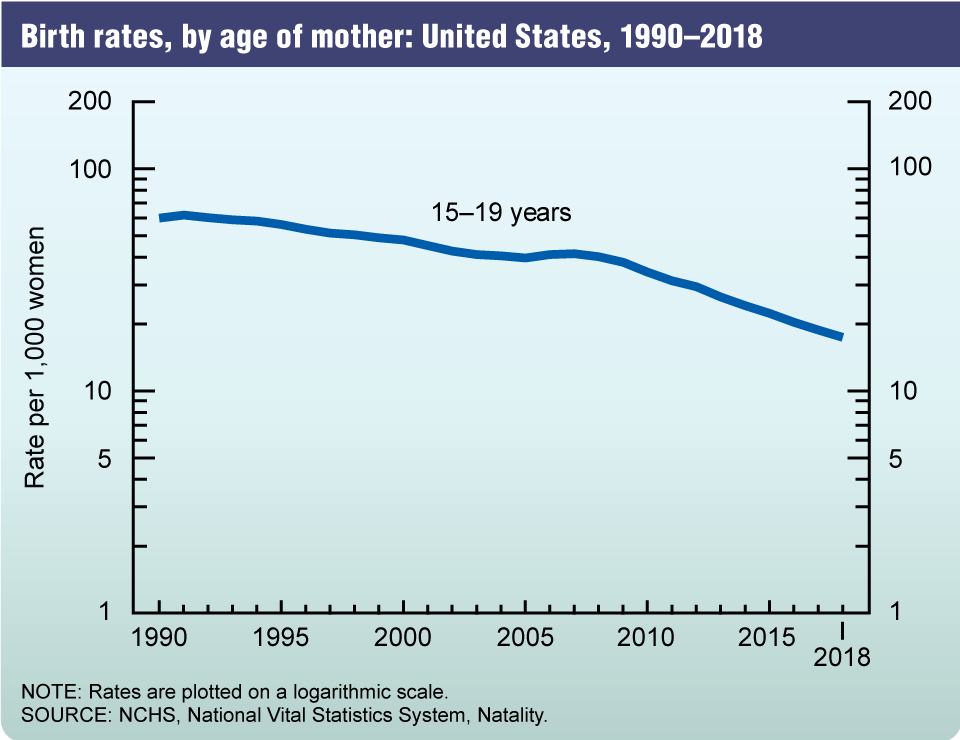 image icon
NOTES: Rates are plotted on a logarithmic scale.
SOURCE: NCHS, National Vital Statistics System, Natality.
Diabetes among adults aged 18 and over
Diabetes is a chronic disease that affects how food is converted to energy, and can affect multiple organs and lead to serious health complications. Prevalence of diagnosed diabetes by race and ethnicity from the National Health Interview Survey, January–June 2018, shows:
- The age- and sex-adjusted prevalence of diagnosed diabetes was 12.4% for Hispanic, 11.5% for non-Hispanic black, and 7.7% for non-Hispanic white adults.
- Hispanic adults were more likely than non-Hispanic white adults but not significantly different from non-Hispanic black adults to have diagnosed diabetes. Non-Hispanic black adults
were more likely than non-Hispanic white adults to have diagnosed diabetes.
Breast cancer among women aged 50–74
During 2015–2017:
- 5.3% of U.S. women aged 50–74 had ever been told they had breast cancer.
- Non-Hispanic white women were more likely to have ever been told they had breast cancer (6.1%) compared with Hispanic women (3.2%) and non-Hispanic black women (3.6%).
- There was no significant difference in the prevalence of breast cancer between Hispanic women and non-Hispanic black women.
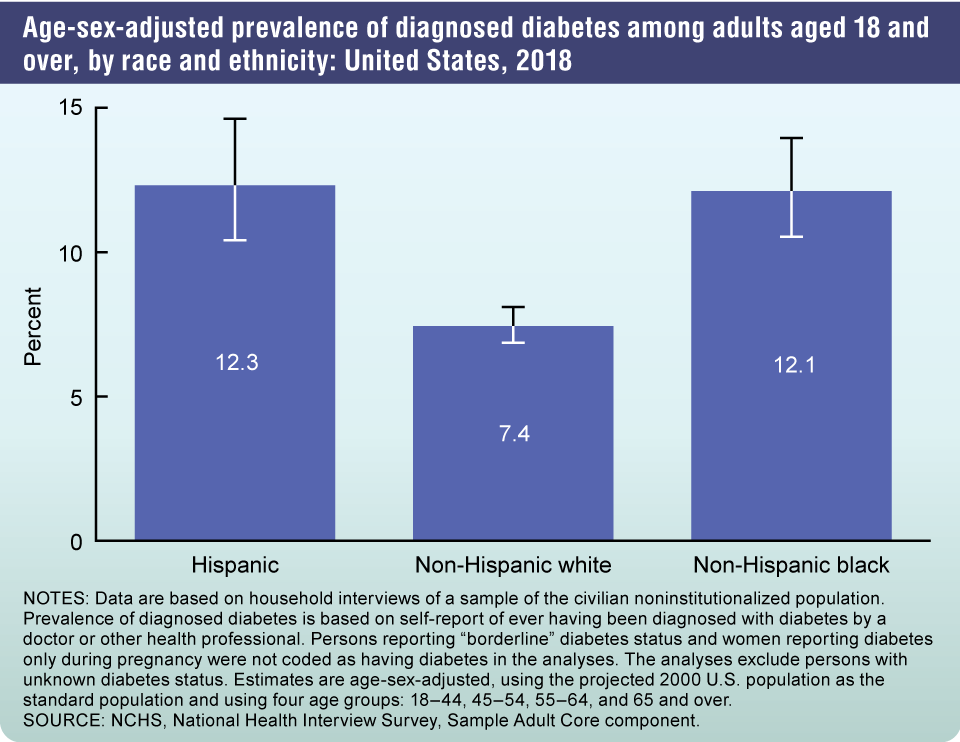 image icon
NOTES: Data are based on household interviews of a sample of the civilian noninstitutionalized population. Prevalence of diagnosed diabetes is based on self-report of ever having been diagnosed with diabetes by a doctor or other health professional. Persons reporting “borderline” diabetes status and women reporting diabetes only during pregnancy were not coded as having diabetes in the analyses. The analyses exclude persons with unknown diabetes status. Estimates are age-sex-adjusted, using the projected 2000 U.S. population as the standard population and using four age groups: 18–44, 45–54, 55–64, and 65 and over.
SOURCE: NCHS, National Health Interview Survey, Sample Adult Core component.
Racial and ethnic disparities data sources
National Vital Statistics System (NVSS)—Collects information from birth certificates in all 50 states and Washington, D.C., including detailed age and race and ethnicity characteristics. Because all births are part of this database, it provides the detail needed for monitoring annual changes in teenage pregnancy and for disparity research.
For more information about NVSS, visit https://www.cdc.gov/nchs/nvss.htm.
National Health Interview Survey (NHIS)—Collects information on the nation’s health through personal household interviews that measure health status and disability, selected conditions, insurance coverage, access to care, use of health services, immunizations, health behaviors, injury, and the ability to perform daily activities.
For more information about NHIS, visit https://www.cdc.gov/nchs/nhis.
Keywords: teen births, diagnosed diabetes, diagnosed breast cancer