CDC in Namibia
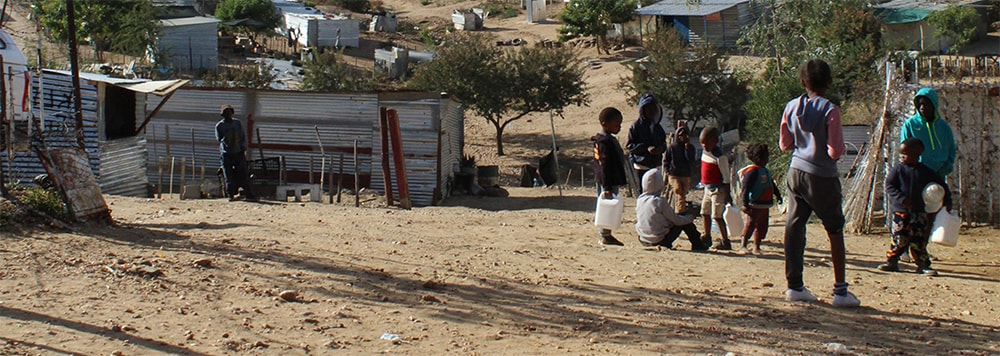
One of the informal settlements in Windhoek, capital of Namibia. Photo by Rachel Coomer/CDC.
The Centers for Disease Control and Prevention (CDC) established an office in Namibia in 2002 to focus on implementing HIV programs in regions with high HIV burden. CDC partners with the Namibia Ministry of Health and Social Services (MOHSS) to strengthen the capacity of Namibia’s healthcare workforce and systems to prevent, detect, and respond to public health threats. A primary focus for CDC and MOHSS is to control the HIV and tuberculosis (TB) epidemics through tailored strategies that prevent new infections, reduce deaths, and improve quality of life. CDC supports MOHSS through a multi-pronged approach that includes strengthening clinical and laboratory systems through the MOHSS Quality Management framework; supporting human resources for health systems to build and maintain an effective health workforce; and optimizing health information systems to ensure that data are available to inform clinical care and policy making.
CDC Impact in Namibia
Global Health Security
Countries that have strong and resilient public health systems can quickly prevent, detect, and respond to infectious disease threats before they become epidemics. CDC strengthens emergency preparedness, provides technical support for infectious disease outbreaks, and supports border health services. CDC is also assisting the establishment of a national Emergency Operations Center and National Institute of Public Health. CDC and MOHSS strengthen the national health system by increasing workforce capacity to detect and respond to outbreaks.

CDC is supporting partners to strengthen global health security policies and procedures so that Namibia has a strong framework in place to respond to disease outbreaks

Over the past 10 years, more than 220 participants have graduated from the Namibia Field Epidemiology and Laboratory Training Program (FELTP). Two cohorts graduated from FELTP-Frontline in 2022

CDC Namibia has supported a range of outbreak investigations, including: mpox, Crimean-Congo hemorrhagic fever, rabies among livestock with human exposures, anthrax in animals, cholera, typhoid, listeriosis, measles, scabies, hepatitis E, schistosomiasis, and H1N1 influenza

Namibia joined the International Association of National Public Health Institutes (NPHIs) in 2016. CDC provides ongoing support to establish an NPHI in Namibia

Namibia conducted a Threat and Hazard Identification and Risk Assessment evaluation in 2017, joined the Global Health Security Agenda in 2019, and launched a National Action Plan for Health Security in December 2020
Human Resources for Health
CDC supports human resources for health at the facility, district, regional, and national levels. CDC partners with the MOHSS to ensure that staff are in the right place to meet local needs and that mechanisms are in place for rapid recruitment, deployment, and ongoing human resources management systems.

CDC Namibia supports over 600 healthcare workers within the MOHSS. In one year, these staff provide more than 2 million hours of work that benefits local and global health security

In 2022, CDC conducted an emergency preparedness capacity assessment and helped train over 100 rapid responders in 4 regions
HIV/AIDS
As a key implementer of the U.S. President’s Emergency Plan for AIDS Relief (PEPFAR), CDC works with Namibia to develop and implement sustainable, integrated, and high-impact HIV prevention, care, and treatment programs. CDC works with MOHSS to scale up national HIV and TB programs, including:
- HIV testing services such as index testing
- Prevention of mother-to-child transmission (PMTCT)
- Antiretroviral treatment (ART)— including introduction of the best HIV medicines and multi-month prescriptions— and treatment of opportunistic infections
- Pre-exposure prophylaxis for pregnant and breastfeeding women
- Cervical cancer screening and treatment
Namibia has nearly achieved HIV epidemic control and is focused on ensuring that all people, especially children and adolescents, receive client-centered prevention and care packages. CDC supports MOHSS to offer services in the community, which is more convenient for patients and reduces pressure at facilities. CDC also supports the broader healthcare needs of patients with HIV.

In 2022, Namibia almost surpassed the UNAIDS 95-95-95 goals and was estimated to be at 94-97-93. This means that 94% of people living with HIV know their status, 97% of people who know their status are on treatment, and 93% of people on treatment achieve viral load suppression

In June 2022, CDC Namibia supported the MOHSS to transition all eligible children and adolescents on ART in Namibia to a dolutegravir (DTG) based regimen, which is currently the best possible treatment for people living with HIV

The estimated number of people dying from HIV in Namibia is 3 times lower than in 2002

The estimated rate of new HIV infections in Namibia is 5 times lower than in 2002

CDC supported Namibia’s population-based HIV impact assessment (NAMPHIA 2017), which provided critical direction for TB and HIV programmatic decisions
COVID-19
Global health security investments and decades of global partnership built a strong foundation in Namibia to respond to the COVID-19 pandemic. CDC’s history of supporting outbreak responses, implementing and evaluating HIV, TB, malaria, and polio programs, and preparing for influenza and other pandemic diseases were vital to the country’s COVID-19 response. CDC’s COVID-19 support in Namibia includes:
- Response and logistics coordination
- Enhancing diagnostic capacity
- Disease surveillance and case management
- Quarantine management
- Case investigation
- Infection prevention and control
- Risk communication
- Activities that promote vaccine uptake
CDC technical staff were involved in all of the major COVID-19 response pillars in Namibia. Technical staff supported development of over 40 standard operating procedures, guidelines, flyers and letters issued by three different Ministries

CDC supported the development and use of an electronic data system, dashboards, and other tools that provide access to critical COVID-19 data. As of October 2022, these data include information on more than 1 million tests, more than 166,000 confirmed cases, and more than 570,000 people who have been vaccinated against COVID-19
CDC trained over 25 staff from 8 laboratories in COVID-19 molecular biology techniques

CDC helped purchase critical laboratory equipment, including: COVID-19 test kits, 30 centrifuges, 15 vortex mixers, 12 biosafety cabinets, 10 refrigerators, 10 freezers, one ultra-cold freezer, sequencing equipment, testing supplies and accessory equipment, reagents, and thousands of personal protective equipment (11,000 face shields, and 3,000 nasal testing swabs)
CDC supported COVID-19 vaccine roll-out by training more than 300 healthcare providers and procuring an ultracold freezer

CDC partnered with the MOHSS to ensure that robust HIV and TB services continued throughout the pandemic
Laboratory Capacity Building
Strong laboratory systems and networks enable timely detection of emerging diseases and rapid response to public health threats. Effective systems and networks also provide critical health information and create safer handling and transportation of laboratory samples. CDC supports the MOHSS to strengthen the quality of the national laboratory system in Namibia. CDC provides technical and financial support to the Namibia Institute of Pathology (NIP) to ensure accurate testing services for TB, HIV, and other related conditions. CDC also works with NIP to ensure the quality of all HIV and TB testing across the country. During the COVID-19 pandemic, CDC supported the national COVID-19 testing system to design workflows, conduct trainings, and ensure biosafety in the laboratory at all times. CDC also supports the development of testing protocols and procedures for specific diseases as outbreaks occur.

With CDC support, the Namibia Institute of Pathology introduced laboratory innovations such as barcode printers and delivery of results via text message. Both innovations decrease the time it takes to get results back to patients and providers

Namibia conducts all of the country’s COVID-19 testing and quickly increased capacity from zero tests per day at the start of the pandemic to more than 2,500 per day

Early in the COVID-19 pandemic, Namibia’s testing laboratory had a backlog of over 10 days until test results were ready. With CDC support, test results are now reported within 24-72 hours after samples are received for testing
Tuberculosis (TB)
Namibia is estimated to have one of the highest TB burdens in the world. CDC partners with the MOHSS to protect healthcare workers and reduce the spread of TB through trainings and capacity-strengthening, especially related to use of particulate-filtering respirators. CDC supports comprehensive TB and HIV activities in Namibia, including:
- Improving and integrating services for people living with TB and HIV coinfections
- Addressing gaps in TB case-finding through improved screening processes and diagnostics
- Providing TB preventative treatment for all eligible people living with HIV
- Supporting TB infection control in healthcare facilities
- Scaling up contact tracing for all people who are exposed to someone with infectious TB

To improve diagnosis of TB, CDC helps procure TB laboratory tests and provides trainings to health care workers on how to identify the signs and symptoms of TB

CDC supported the Namibia Institute of Pathology (NIP) and MOHSS to use molecular testing instead of smear microscopy for TB diagnostic testing

CDC supported MOHSS to roll out a new urine test (TB-LAM) for TB diagnosis. Compared to other tests, TB-LAM is more effective in diagnosing TB among people living with HIV and saves lives by helping people start treatment sooner
CDC has supported MOHSS to launch a new three-month TB preventative treatment regimen, which reduces treatment time by half and makes it easier for patients to complete the regimen
Health Information Systems
CDC assists with a range of innovative and cost-effective strategies that enhance data collection, analysis, and health management and information systems. CDC provides technical and infrastructure support to the MOHSS to develop and maintain national client-level health information systems that include HIV testing, treatment, PMTCT, TB, and COVID-19 cases and vaccinations. CDC also supports the MOHSS with the national health information management system (District Health Information System or DHIS2), which collects aggregated data and produces summary reports for key indicators. CDC’s support helps ensure that MOHSS staff, from health facilities up to the national programs, have access to the critical information they need to inform decision-making.

CDC supports integration and interoperability of data systems to ensure that patient-level data is available and used for decision-making that leads to improved client outcomes

CDC supported an MOHSS delegation at the CDC Atlanta 2022 Intergovernmental Learning Exchange to Advance Data-Driven Decision Making (I-LEAD) workshop
Making Schools in Namibia Safer During the COVID-19 Pandemic l CDC
When borders are shut: Providing ART medicine to all patients during the COVID-19 pandemic | CDC
Treating TB During the Time of COVID-19 | CDC
Q&A with CDC Namibia Country Director Dr. Eric Dziuban | Blogs | CDC
An interview with Anita Beukes, Laboratory Advisor | Blogs | CDC
- 10 U.S. Assignees
- 39 Locally Employed
- Population: > 2.5 million
- Per capita income: $9,220
- Life expectancy: F 65 / M 51 years
- Infant mortality rate: 30/1,000 live births
Sources: World Bank 2021, Namibia; Population Reference Bureau 2021, Namibia


