CDC in Botswana
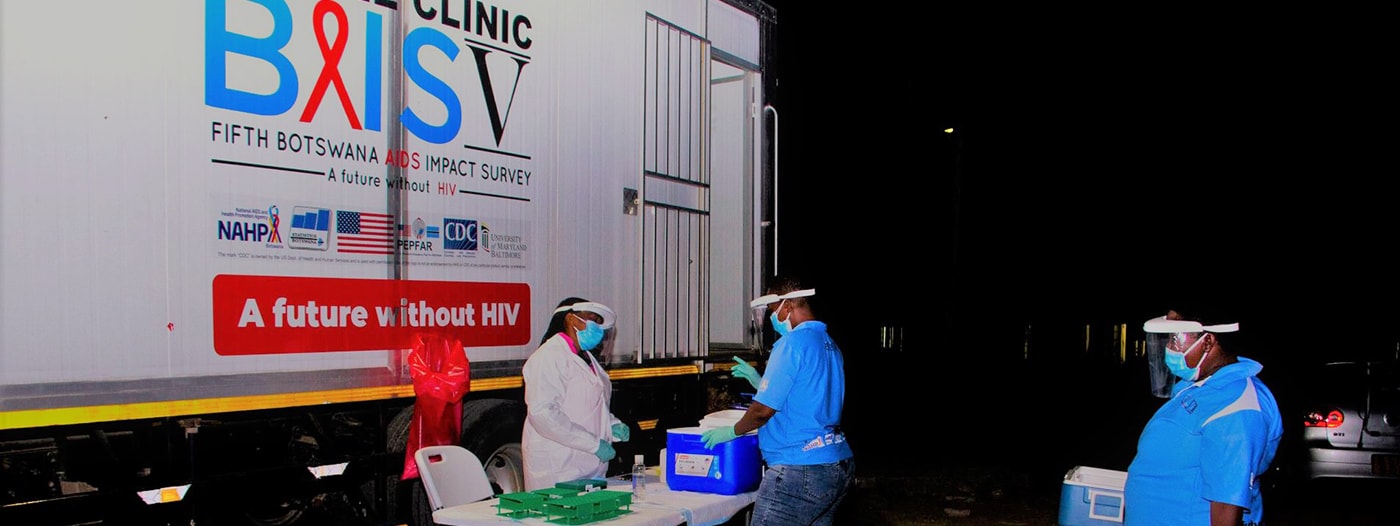
Members from the Fifth Botswana AIDS Impact Survey (BAIS V) delivering medical samples to the satellite laboratory.
The Centers for Disease Control and Prevention (CDC) established an office in Botswana in 1995 to strengthen tuberculosis prevention and control. In 2000, the partnership grew to include HIV prevention, treatment, and strategic information program development to maximize Botswana’s response to the HIV epidemic. CDC continues collaboration with the Botswana Ministry of Health and Wellness (MOHW), providing technical assistance and research to support HIV and TB control programs, injury prevention, and emergency response operations.
CDC Impact in Botswana
Global Health Security
Countries that have strong and resilient public health systems can quickly prevent, detect, and respond to infectious disease threats before they become epidemics. CDC’s global health security work in Botswana focuses on building capacity across four core areas:
- Health information management and disease surveillance
- Laboratory systems
- Workforce development
- Emergency management and response
Botswana has made significant progress adopting the Integrated Disease Surveillance and Response (IDSR) guidelines to facilitate surveillance and timely response to disease outbreaks. This is in line with the WHO 2005 International Health Regulations. With CDC support, the Field Epidemiology Training Program (FETP) strengthens the public health workforce for real time disease surveillance.

When COVID-19 prevented in-person meetings, CDC helped MOHW conduct virtual Training of Trainers (TOT) on disease surveillance and response for all 18 district health management teams

CDC worked with partners in 2020 to adopt the revised third edition of WHO Integrated Disease Surveillance and Response technical guidelines

CDC worked with partners to develop and implement a National Action Plan for Health Security in 2018
COVID-19
Global health security investments and decades of global cooperation and support to respond to outbreaks have built strong foundations upon which to address the coronavirus pandemic. In Botswana, CDC is supporting response coordination, surveillance, diagnostic capacity, quarantine management, case investigation, infection prevention and control, and risk communication activities. This work builds on past collaborations to control HIV, TB, and to prepare for influenza outbreaks and other diseases of public health importance.

CDC provided technical assistance to develop and deploy the COVID-19 national data tracker in 2020. The tracker monitors COVID-19 cases and vaccinations

CDC helped establish and decentralize COVID-19 testing to six PCR laboratory sites and over 600 rapid diagnosis test sites

CDC supported Botswana to develop National Surveillance Guidelines for human infection with COVID-19 in 2020

CDC helped develop Botswana’s National COVID-19 Vaccine Deployment Plan in collaboration with the MOHW Interagency Coordination Committee

CDC supported the COVID-19 Intra Action Review in Botswana, leading to system improvements across most areas of the response

CDC helped procure key laboratory equipment (including supplies and reagents), additional space for COVID-19 screening and isolation (such as tents and chairs) to decongest facilities, and provided personal protective equipment (including gowns, masks, sanitizers and gloves) for health workers
HIV and Tuberculosis (TB)
HIV and TB are the world’s two most deadly infectious diseases. TB is the leading cause of death for individuals living with HIV. As a key implementer of the U.S. President’s Emergency Plan for AIDS Relief (PEPFAR), CDC works with Botswana’s MOHW to build a robust national HIV response. CDC efforts include:
- HIV testing
- HIV Pre-Exposure Prophylaxis (PrEP)
- Linkage and retention to HIV antiretroviral treatment services
- Prevention of mother-to-child transmission
- Voluntary medical male circumcision programs
- TB prevention and control programs
- Cervical cancer prevention and control
- Working with populations most impacted by HIV in targeted districts of the country
- Determined Resilient Empowered AIDS-Free Mentored and Safe program (DREAMS) for adolescent girls and young women
CDC helps Botswana ensure the quality of HIV services and programs. The voluntary medical male circumcision program helps keep boys and men HIV-free. The services are provided at fixed sites and in school campaigns. CDC’s implementing partners enhance the quality of these services through training, mentoring, site monitoring visits, and remediation plans.
CDC works with MOHW and implementing partners to strengthen laboratories and surveillance systems to diagnose both HIV and TB quickly and accurately. CDC supports quality laboratory testing for the diagnosis and treatment of people living with HIV and TB, and population level surveys for HIV.

98% of HIV-positive pregnant women received antiretroviral treatment in 2020

Mother-to-child HIV transmission has been reduced to 1.91% in Botswana (UNAIDS Spectrum estimate in 2020)

Botswana achieved over 97% viral load suppression among HIV patients on antiretroviral treatment

99% of patients with confirmed TB were tested for HIV as of September 2020
Laboratory Capacity Building
CDC works with MOHW to build laboratory capacity to:
- Improve availability and access to laboratory services that include HIV and TB diagnosis, viral load testing, early infant diagnosis, and testing for advanced diseases/opportunistic infections
- Implement international laboratory standards that strengthen quality of testing and monitoring of diagnostics
- Establish routine surveillance and response to public health emergencies
- Improve the availability, quality, and use of laboratory data for evidence-based planning and decision making
- Foster collaboration between human, animal, and environmental health laboratories for a One Health approach under the Botswana Public Health Institute
- Implement continuous quality improvement initiatives
- Introduce new diagnostic methods and technologies

With CDC support, seven public health laboratories received international standard accreditation (ISO:15189) and one laboratory has been WHO-certified

Decentralized HIV diagnosis to more sites across the country, including 876 testing sites, 27 viral load sites, and 54 TB sites

Introduced new technologies leading to increased efficiencies in diagnosis of TB and other opportunistic infections
Patient care has improved thanks to stronger lab-clinic interphase, faster lab turnaround times, and fewer incorrect diagnoses
Health Systems Strengthening
CDC is working with MOHW and the International Association of Public Health Institutes to establish the Botswana Public Health Institute (BPHI). BPHI will focus on laboratory research, surveillance, and emergency response. National Public Health Institutes help countries conduct essential public health functions and serve as homes for their nation’s public health systems and expertise. CDC helps countries develop and strengthen these institutions to protect public health and contain disease close to the source.
CDC helped establish and supports the FETP frontline course. CDC also strengthens quality management systems among health workers. CDC works with MOHW and partners to design and implement population-based surveys, such as the Botswana AIDS Impact Survey (BAIS), the Youth Risk Behavior and Biological Survey (YRBBS), and the Violence Against Children Survey (VACS).
CDC helped establish the Botswana Public Health Laboratory and Botswana National Quality Assurance laboratories

CDC helped establish and supports the Quality Assurance Department for MOHW and Quality Improvement Teams at District-level health facilities

CDC provided training for district health teams in field epidemiology and laboratory methods
- 5 U.S. Assignees
- 36 Locally Employed
- Population: > 2,300,000
- Per capita income: >$17,000
- Life expectancy: M 62 years / F 66
- Infant mortality rate: 28/1,000 live births
Sources: World Bank, Population Reference Bureau


