|

|

Health Topics
Tobacco Use
School Health Guidelines
Summary
Each day, more than 3,900 young people across the United States try
their first cigarette.1 Most start this deadly habit not fully
understanding that nicotine in tobacco is as addictive as heroin,
cocaine, or alcohol. Most also underestimate the health consequences,
even though tobacco use is the leading cause of preventable death in the
United States. School programs to prevent tobacco use among young people
can make a major contribution to the health of the nation, particularly
when these programs are combined with community efforts.
Benefits of Preventing Tobacco Use Among Young People
- Helps prevent long-term health problems and premature death.
- Promotes optimal health and decreases school days missed because
of respiratory illnesses.
- Dramatically decreases the likelihood that a young person will
be a regular tobacco user as an adult.
Consequences of Tobacco Use
- Tobacco use causes more premature deaths in the United States
than any other preventable risk.
- If current patterns of smoking behaviors continue, an estimated
6.4 million of today's children can be expected to die prematurely
from smoking-related illnesses.2
- Cigarette smoking causes heart disease; stroke; chronic lung
disease; and cancers of the lung, mouth, pharynx, esophagus, and
bladder.3,4
- Cigarette smoking increases coughing, shortness of breath, and
respiratory illnesses; decreases physical fitness; and adversely
affects blood cholesterol levels.3,4
- Smokeless tobacco is not a safe alternative to cigarettes. Using
it causes cancers of the mouth, pharynx, and esophagus; gum
recession; and an increased risk for heart disease and stroke.3,4
- Smoking cigars increases the risk of oral, laryngeal,
esophageal, and lung cancers.4,5
- Secondhand smoke puts children in danger of developing severe
respiratory diseases and can hinder the growth of their lungs.6
- Exposure to secondhand smoke as a child or adolescent may
increase the risk of developing lung cancer as an adult,7 or worsen
existing asthma.8
- Tobacco use causes stained teeth, bad breath, and foul-smelling hair
and clothes.3
Tobacco Use By Teens
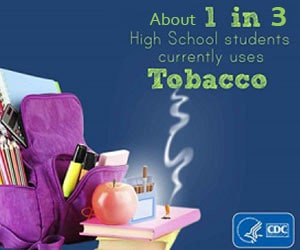
- Although the percentage of high school students who smoke cigarettes has
declined since 1997, rates remain high: 23% of high school students were
current smokers (smoked cigarettes on 1 or more of the 30 days preceding
the survey) in 2005, compared with 22% in 2003, 29% in 2001, 35% in
1995 and 28% in 1991.11
- Fifty-four percent of high school students have ever tried cigarette
smoking (even one or two puffs).11
- Sixteen percent of high school students have smoked a whole cigarette
before the age of 13.11
- Eight percent of high school students have used smokeless tobacco on
one or more of the 30 days preceding the survey, and rates are higher among male
(14%) than female (2%) high school students.11
- Fourteen percent of high school students have smoked cigars,
cigarillos, or little cigars on one or more of the 30 days preceding the
survey.11
- The younger people begin smoking cigarettes, the more likely they are
to become strongly addicted to nicotine.3
- Young people who try to quit suffer the same nicotine withdrawal
symptoms as adults who try
to quit.3
- Among high school students who currently smoked, 55% tried to quit
smoking during the 12 months preceding the survey.11

The Opportunity
Well-designed, well-implemented school programs to prevent tobacco use
and addiction:
- Have proved effective in preventing tobacco use.
- Provide prevention education during the years when the risk of becoming
addicted to tobacco is greatest.
- Provide a tobacco-free environment that establishes nonuse of tobacco as
a norm and offers opportunities
for positive role modeling.
- Can help prevent the use of other drugs, especially if the program
addresses the use of these substances.
CDC’s Guidelines for School Health Programs
CDC’s Guidelines for School Health Programs to
Prevent Tobacco Use and Addiction were designed
to help achieve national health and education goals. They were developed in collaboration with experts from 29 national,
federal, and voluntary agencies and are based on an extensive review of
research and practice.
Key Principles
School programs to prevent tobacco use and
addiction will be most effective if they:
- Prohibit tobacco use at all school facilities and events.
- Encourage and help students and staff to quit using tobacco.
- Provide developmentally appropriate instruction in grades K–12 that
addresses the social and psychological causes of tobacco use.
- Are part of a coordinated school health program through which teachers,
students, families, administrators, and community leaders deliver
consistent messages about tobacco use.
- Are reinforced by communitywide efforts to prevent tobacco use and
addiction.

Recommendations
The guidelines include seven recommendations for ensuring a quality
school program to prevent tobacco use.
- Policy
Develop and enforce a school policy on tobacco use.
The policy, developed in collaboration with students,
parents, school staff, health professionals, and school
boards, should:
- Prohibit students, staff, parents, and visitors from using tobacco on
school premises, in school vehicles, and at school functions.
- Prohibit tobacco advertising (e.g., on signs, T-shirts, or caps or
through sponsorship of school events) in school buildings, at school
functions, and in school publications.
Require that all students receive instruction on avoiding tobacco use.
- Provide access and referral to cessation programs for students and
staff.
- Help students who violate tobacco-free policies to quit using
tobacco rather than
just punishing them.
- Instruction
Provide instruction about the short- and long-term
negative physiologic and social consequences of
tobacco use, social influences on tobacco use, peer
norms regarding tobacco use, and refusal skills. This
instruction should:
- Decrease the social acceptability of tobacco use and show that most
young people do not smoke.
- Help students understand why young people start to use tobacco and
identify more positive activities to meet their goals.
- Develop students’ skills in assertiveness, goal setting, problem
solving, and resisting pressure from the media and peers to use tobacco.
Programs that only discuss tobacco’s harmful effects
or attempt to instill fear do not prevent tobacco use.
- Curriculum
Provide tobacco-use prevention education in grades K–12.
- This instruction should be introduced in elementary school and
intensified in middle/ junior high school, when students are exposed to
older students who typically use tobacco at higher rates.
- Reinforcement throughout high school is essential to ensure that
successes in preventing tobacco use do not dissipate over time.
- Training
Provide program-specific training on tobacco-use prevention for
teachers. The training should include reviewing the curriculum, modeling
instructional activities, and providing opportunities to practice
implementing the lessons. Well-trained peer leaders can be an important
adjunct to teacher-led instruction.
- Family Involvement
Involve parents or families in supporting school-based programs to prevent tobacco use. Schools should:
- Promote discussions at home about tobacco use by assigning homework and
projects that involve families.
- Encourage parents to participate in community efforts to prevent tobacco
use and addiction.
- Tobacco-Use Cessation Efforts
Support cessation efforts among students and school staff who use
tobacco. Schools should provide access to cessation programs that help
students and staff stop using tobacco rather than punishing them for
violating tobacco-use policies. - Evaluation
Assess the tobacco-use prevention program at regular intervals. Schools
can use CDC’s Guidelines for School Health Programs to Prevent Tobacco
Use and Addiction to assess whether they are providing effective
policies, curricula, training, family involvement, and cessation
programs.
May 2006
References
-
Substance Abuse and Mental Health Services
Administration. Results from the
2004 National
Survey on Drug Use and Health: (Office
of Applied Studies). Rockville, Maryland: U.S. Department of Health and Human
Services, 2005;NSDUH Series H-27;DHHS publication no. (SMA) 05-4061.
-
CDC. Office of Smoking and Health 2002 calculations based upon: Smoking
attributable mortality and years of
potential life loss—United States, 1984. Morbidity & Mortality Weekly
Report 1997;46:444–451.
-
CDC. Preventing Tobacco Use Among Young People, A Report of the Surgeon
General. Atlanta, GA: U.S. Department
of Health and Human Services, 1994.
-
CDC. The Health Consequences of Smoking, A Report of the Surgeon
General. Atlanta, GA: U.S. Department of Health and Human Services,
2004.
-
CDC. Cigar smoking among teenagers—United States, Massachusetts, and New York,
1996 [pdf 300K]. Morbidity & Mortality
Weekly Report 1997;46(20):433–440.
-
CDC.
Secondhand smoke
exposure among middle and high school students—Texas, 2001
[pdf 210K]. Morbidity & Mortality Weekly Report
2003;52(8):152–154.
-
Substance Abuse and Mental Health Services Administration. U.S.
Department of Health and Human Services. Summary of Findings from the
2000 National Household Survey on Drug Abuse, 2001.
-
Glantz SA, Parmley WW. Passive smoking and heart disease: mechanisms and
risk. Journal of the American Medical Association
1995;273(13):1047-1053.
-
Mokdad AH, Marks JS, Stroup DF, Gerberding JL. Actual causes of death in
the United States, 2000. Journal of the American Medical Association
2004;291:1238–1245.
-
CDC, National Center for Injury Prevention and Control, Office of
Statistics and Programming. Web-based Injury Statistics Query and
Reporting System (WISQARS). Accessed May 31, 2006.
-
CDC.
Youth Risk Behavior Surveillance—United States, 2005
[pdf 300K]. Morbidity & Mortality Weekly Report 2006;55(SS-5):1–108.
Back to Top
Documents on this page are available in
Portable Document Format (PDF). Learn more about viewing and printing
these documents with Acrobat
Reader.
|

|